
Focus areas and targets
Focus area 1 - Ethical and transparent business methods
Fingerprints’ success is based on the operations being conducted ethically, transparently and legally since we otherwise risk losing the faith of our stakeholders.
Our Code of Conduct summarizes the areas that are of particular importance to building the confidence of customers and other stakeholders:
• Correct reporting and documentation
• Protect the company’s assets
• Responsible communication
• Protection of sensitive information
• Comply with competition laws
• Secure responsible trade
• Zero tolerance of bribes and corruption
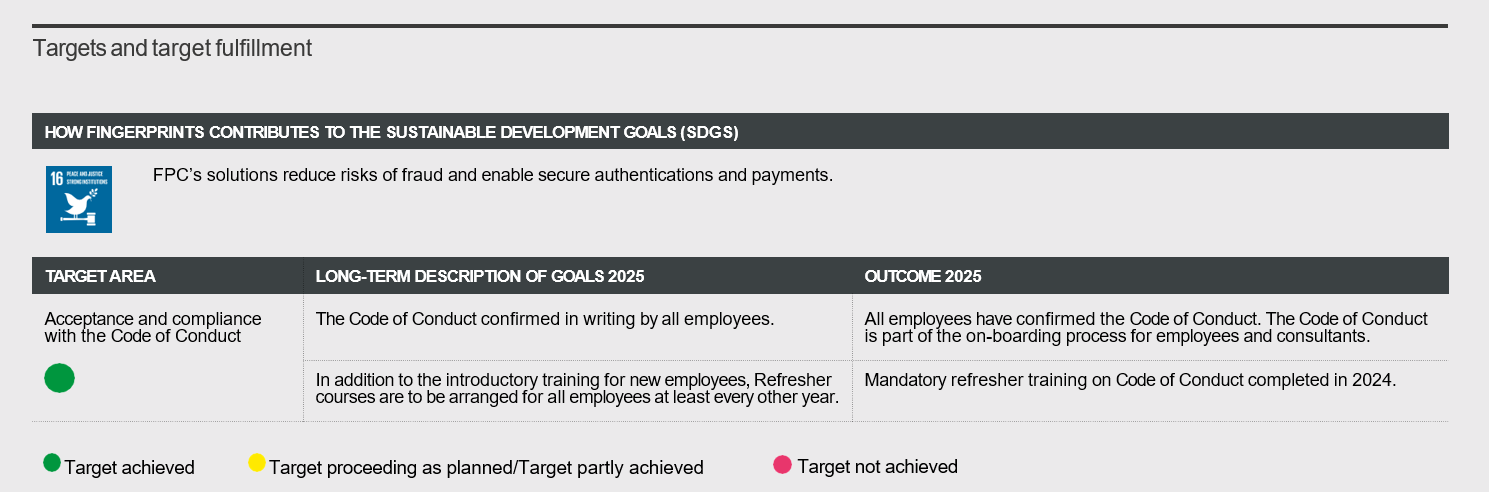
All coworkers must confirm that they have read and understood the Code of Conduct. New employees undergo a review of the Code during their introductory training and refresher courses are implemented for all coworkers every year to ensure continuous awareness and acknowledgment of our guiding principles. In 2023, a new whistleblowing platform was implemented, which allows users to report suspected wrongdoing easily and anonymously. A new whistleblowing policy was also adopted.
Responsible purchases of minerals
Through the global association of industry associations, the World Semiconductor Council (WSC), the global semiconductor industry has undertaken to use procured minerals responsibly in its semiconductor products. WSC recommends that its local members use the OECD’s Due Diligence Guidance for Responsible Supply Chains of Minerals from Conflict-Affected and High-Risk Areas.1 The semiconductor industry has been involved in the development of compliance tools in this area, such as the OECD’s roadmap, and they have subsequently also been adopted by other major industrial sectors.
Risks and risk management
Suspicions of purchases of conflict minerals in the supply chain can lead to a negative impact resulting from rumors and financial consequences for Fingerprints. Accordingly, Fingerprints evaluates its suppliers through the Responsible Minerals Initiative. Fingerprints works actively on implementing its Code of Conduct, which encompasses anti-corruption. Regular refresher courses are an important part of this work, with the focus on the content of the Code. The company’s anti-corruption policy is evaluated and updated whenever required.
Targets and target fulfillment
Focus area 2 - Environmental protection and efficient use of resources
The efficient use of resources and protecting the environment are an important feature of Fingerprints’ sustainability framework for minimizing our climate impact. We are determined to steadily improve our performance and our reporting in this area.
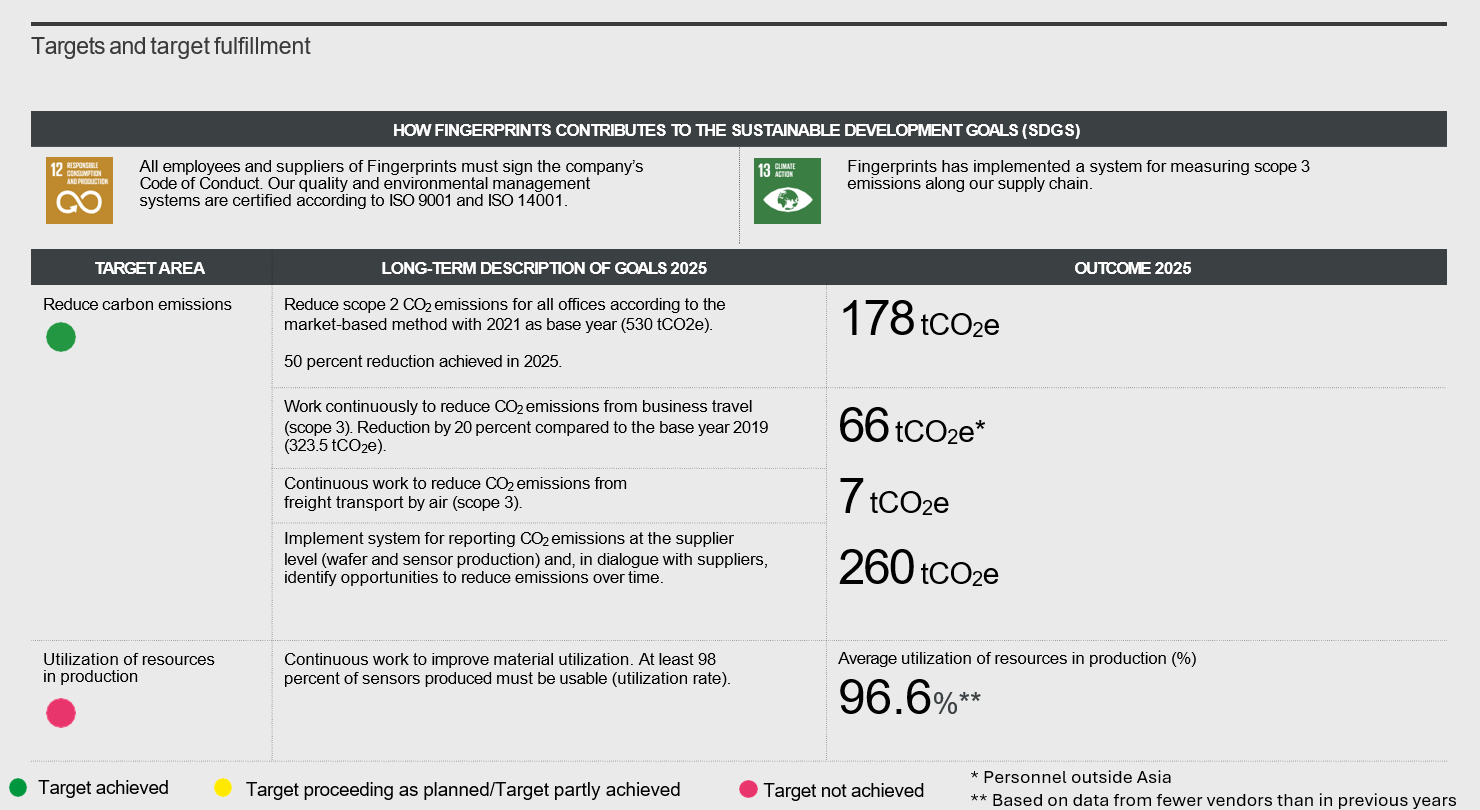
Since Fingerprints does not have any proprietary production capacity, it thus has no direct emissions (scope 1) to report. Our climate-related sustainability targets and reporting in the sustainability reports have historically focused on aspects of the operations that we can directly influence, such as consumption of energy in our offices (scope 2) and business travel (scope 3). However, since 2021 we quantify climate impact along our supply chain (scope 3), in order to enable our stakeholders to better understand the company’s total climate impact and our initiatives to reduce our impact.
Environmental impact in Fingerprints’ supply chain
Fingerprints’ most important suppliers, in terms of purchasing value, are producers of semiconductors. Although the semiconductor industry accounts for a relatively small part of the world’s overall CO2 emissions, it has been working determinedly for a long time to reduce climate impact. A key part of this work has been voluntary reductions in PFC gas emissions. As early as 1999, each regional member organization in the World Semiconductor Council (WSC) – an international forum that brings together industry leaders to address issues of global concern to the semiconductor industry – undertook to reduce their PFC gas emissions by 10 percent by the end of 2010. This goal was comfortably surpassed, with the reduction over this ten-year period amounting to 32 percent, according to WSC. In 2011, a new target was adopted for the coming ten-year period, through 2020, expressed in terms of NER, Normalized Emission Rate, of carbon equivalents per square centimeter of manufactured wafer. The target was set at 0.22 kilos CO2e/cm2, corresponding to a 30-percent reduction compared with the base year of 2010. The WSC also published guidelines (best practices) for new semiconductor plants (updated in 2017). According to WSC, a reduction of 22.9 percent was achieved in 2020, in relation to the base year 2010. In 2023, the WSC announced a new PFC emissions reduction goal for 2030, committing to achieving a reduction of PFC emissions by an additional four percentage points by 2030, compared to the base year 2021. The WSC has also agreed to work on collecting scope 2 emissions, and to continue work toward developing a GHG goal comprising Scope 1 and Scope 2 emissions to be considered by the WSC in the future. The WSC started working on the data collection in 2024.
Semiconductor-enabled digital technologies also contribute to reducing emissions in various other industries, not least by increasing efficiency. For example, World Economic Forum (WEF) estimates show that digital technologies could cut emissions by up to 20 percent by 2050 in the three highest-emitting sectors: energy, materials, and mobility.
The size of the sensors developed and sold by Fingerprints has decreased over the years. The fact is that today we can fit four times as many sensors per silicon wafer than we could five years ago. As a result of this increased efficiency, combined with emissions reductions in the production process, we estimate that CO2 emissions per sold sensor in 2025 were less than one-fourth of the corresponding figure in 2015.
Risks and risk management
A negative environmental impact from Fingerprints or our suppliers risk adversely affecting our brand reputation among customers and markets. The company has assessed its exposure to climate-related risks and does not deem that such risks would have a material impact on its financial position or performance. The company continues to monitor relevant environmental factors as part of its overall risk management process. At the same time, we work actively to achieve our environmental objective for CO2 emissions with the focus on our indirect emissions (scope 3) and the environmental performance of suppliers.
Scope 3
Since 2021, Fingerprints quantifies the company’s indirect CO2 emissions in all relevant Scope 3 categories along the supply chain. Fingerprints’ largest impact on the climate is in the supply chain, particularly connected to semiconductor manufacturing. In 2025, approximately 50 percent of Fingerprints’ carbon footprint was accounted for by the manufacturing of silicon wafers and the integration and packaging of various components into modules that are ready for assembly. Measurement of our indirect emissions is an important step toward better understanding of our total climate impact, and for being able to engage in a dialogue with suppliers and trade organizations about the potential to reduce emissions over time.
As a result of Fingerprints’ decision to wind down the Mobile and PC product groups, the number of sensors delivered decreased significantly in 2025, compared to 2024. This is the key driver behind the reduction in Scope 3 emissions reported for 2025. Our strategy going forward includes a key objective to increase the share of software in our revenue mix. This shift is expected to contribute to a further reduction in greenhouse gas emissions, as software solutions typically have a lower environmental impact compared to hardware production and distribution.
Targets and target fulfillment
Focus area 3 - Smarter and safer solutions
FPC aims to supply its customers with products that fulfill or exceed their expectations to ensure that the company is not outmaneuvered by our competitors. To succeed, we have to ensure that our solutions are modern, innovative and secure.
We are determined to deliver high-quality products and services that are safe, reliable and satisfy statutory requirements. We always have the experiences, comfort and integrity of the end users in mind when we develop biometric solutions, and we work to avoid potential negative environmental or health effects during the use of our products.
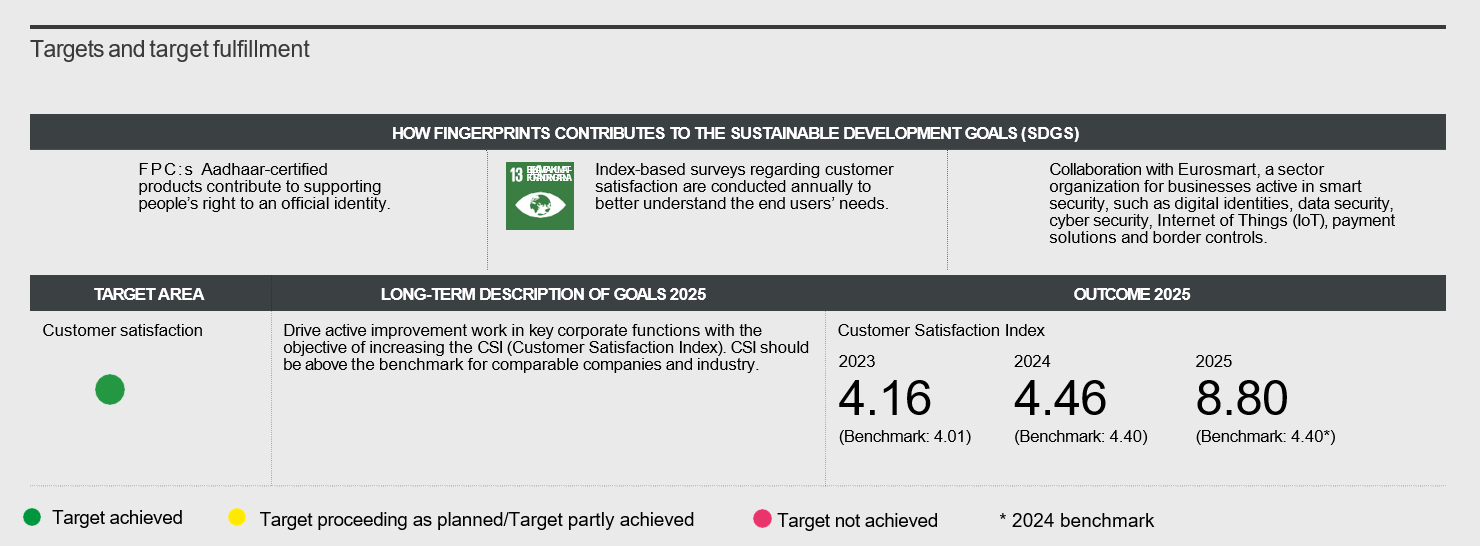
We annually arrange a comprehensive customer satisfaction survey, and continuously develop our methods for collecting data on the needs of customers and end users.
Risks and risk management
Fraud and cyberattacks related to digital payments and digital identity represent a growing risk for consumers and financial institutions. Attackers use, among other methods, stolen identities, account takeovers and social engineering to bypass traditional login and verification mechanisms, which can result in financial losses and reduced trust in digital services.
FPC’s solutions are designed to mitigate these risks through stronger authentication and access control. Biometrics can help bind access and transactions to the rightful user, making it more difficult to misuse stolen credentials. AllKey is an example of how FPC addresses both fraud risk and broader cybersecurity risk by enabling secure and user-friendly authentication across different environments, while we continuously enhance our security measures and communicate transparently about risks and how they are managed.
Targets and target fulfillment
Focus area 4 - Respect and reward our people
The people who work at FPC are from different parts of the world and have varying backgrounds and competencies. With a passion for innovative technical solutions, we create products for secure and smooth identification and authentication.
As coworkers of FPC, we are expected to respect each other, make sure that everyone is given the opportunity to perform optimally and ensure that everyone is acknowledged and rewarded for their efforts and performance. This is significant for our success in retaining and attracting talented employees.
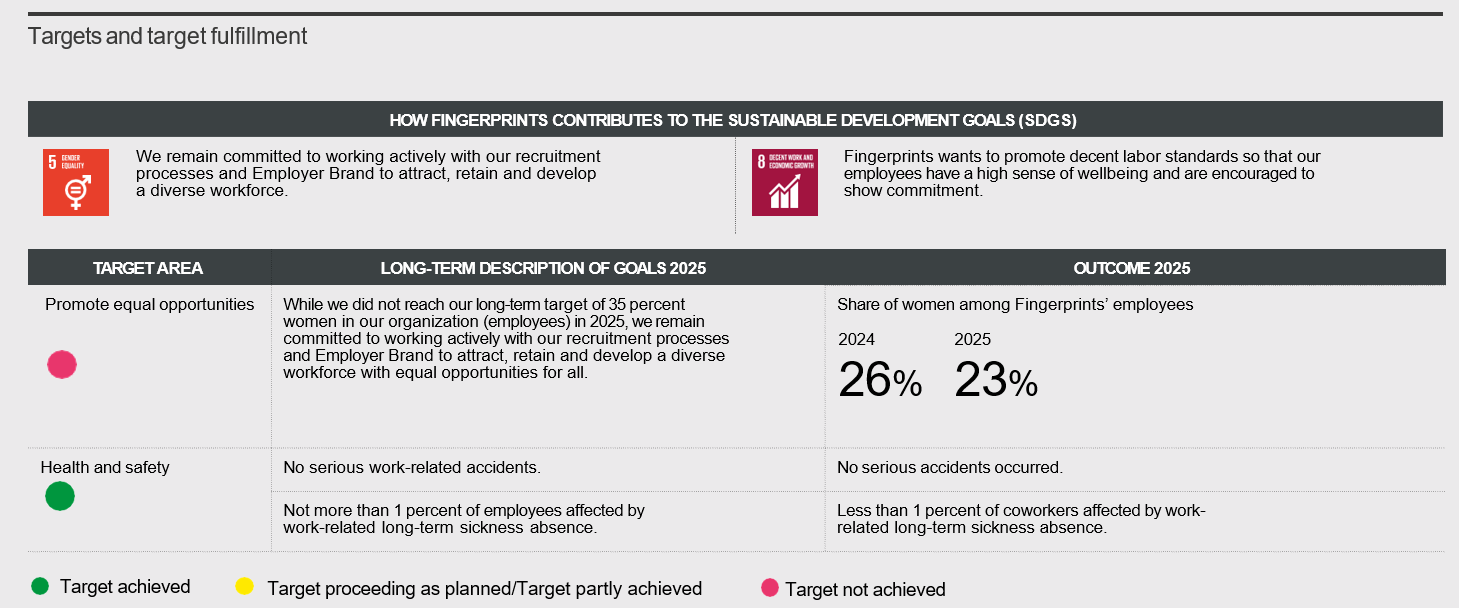
All our coworkers are to have the same opportunities based on competencies, experience and performance regardless of gender, religion, age, functional impairment, sexual preference, nationality, political opinion, social background or ethnic origin. We offer our coworkers a safe, secure and inclusive workplace, where health and safety are prioritized in all respects, at our offices and during our business trips. We shall ensure that we do not violate human rights and that we respect international labor rights. Coworkers are expected to show the same respect and protect the rights of the people who work for suppliers, customers and others with whom we do business or collaborate.
Targets and target fulfillment
Risks and risk management
If we do not succeed in attracting, recruiting and retaining the right skills, we risk not delivering on our goals. If we do not succeed in creating an inclusive work environment characterized by diversity, we risk losing innovative power, productivity, creativity and customer satisfaction. We also risk not being seen as an attractive employer for current and future employees. We work to attract employees with different experiences and backgrounds, which gives us greater competitiveness, increased knowledge and a broader perspective. Working for an inclusive and sustainable work environment is a feature of the company’s strategy.
Adaptation of the organization
2025, as 2024, was characterized by the implementation of our Transformation Plan, initiated at the end of 2023. Cost Optimization and Portfolio Refresh form key parts of the plan, with the objective of reducing operating expenses while exiting commoditized, low-margin markets to focus on profitable growth segments. In 2025, we finalized the wind-down of our PC and Mobile product groups, translating into further headcount reductions and entailing that we are exiting the Chinese market.
We will continue to focus on building an empowered, efficient organization, capable of deploying our talent efficiently, aligning our people with strategic projects quickly as market opportunities evolve.
A sustainable organization
At FPC, we attach considerable importance to monitoring employee wellbeing and engagement, and we work actively to create the best possible conditions for involvement and a sustainable work environment. During 2025, we conducted quarterly employee pulse surveys to track how our employees feel and how they perceive their work situation, and to ensure we capture feedback over time.
In parallel, we continued to maintain an open and ongoing dialogue across the organization. Our HR function worked closely with managers to support employees and encourage continuous feedback. Regular online staff meetings were held throughout the year, providing a forum to communicate updates and address questions. In addition, a digital tool enabling employees to submit questions anonymously to management was available, with responses published on the company intranet.
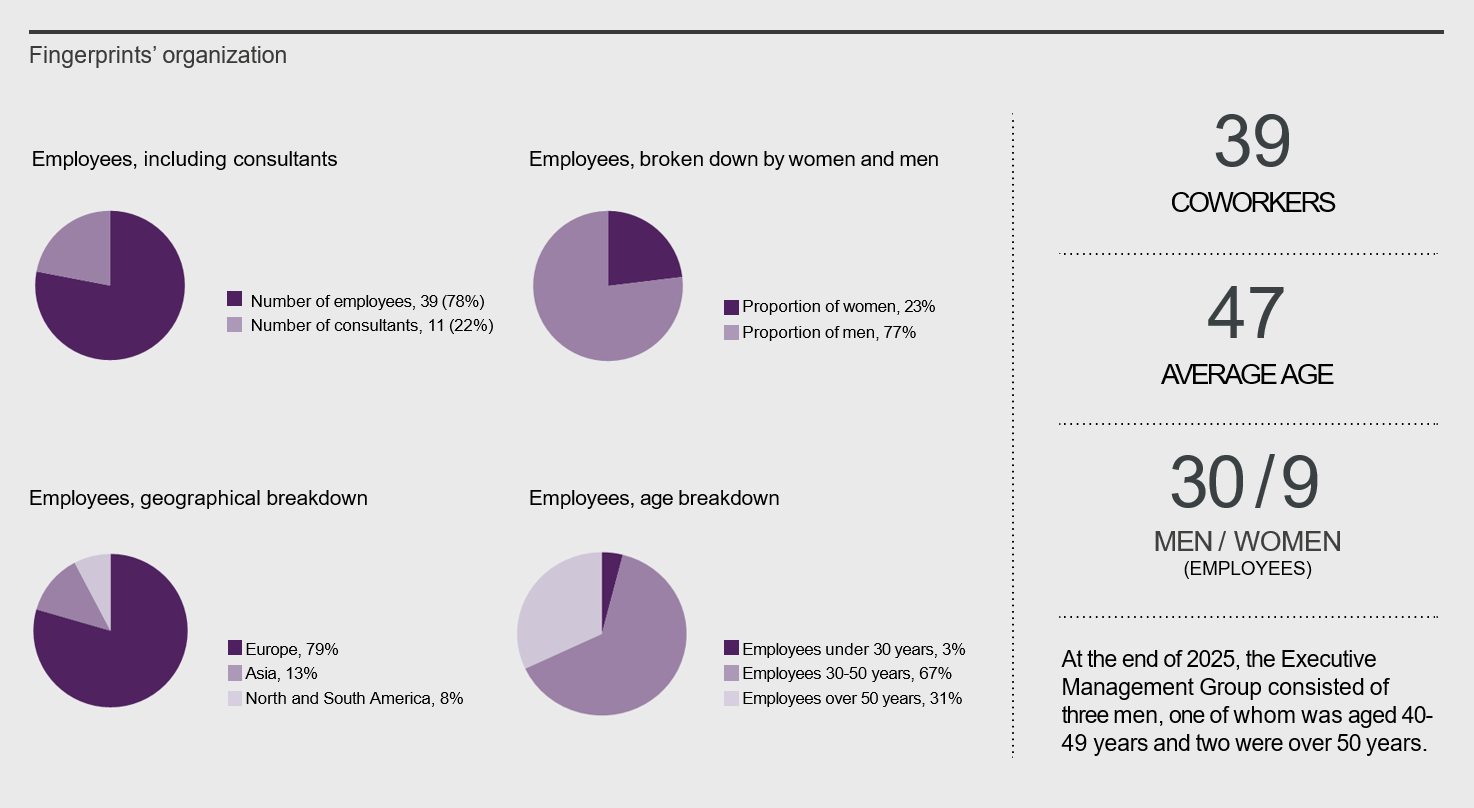
While the significant headcount reductions during 2024 and 2025 has led to a decrease in the share of women among our employees, we remain committed to having a diverse workforce with equal opportunities for all. We support an environment and a culture in which our employees learn from each other and contact their colleagues for advice, support and to share knowledge. With our core values as the point of departure, we encourage our coworkers to learn at work by daring to test new things, accepting new challenges, reserving time for reflection and sharing their experiences of successes and setbacks.

With a passion for innovative technical solutions, we create products for safe and flexible identification and authentication.
Board of Directors
Gothenburg, on the date stated in the electronic signatures.